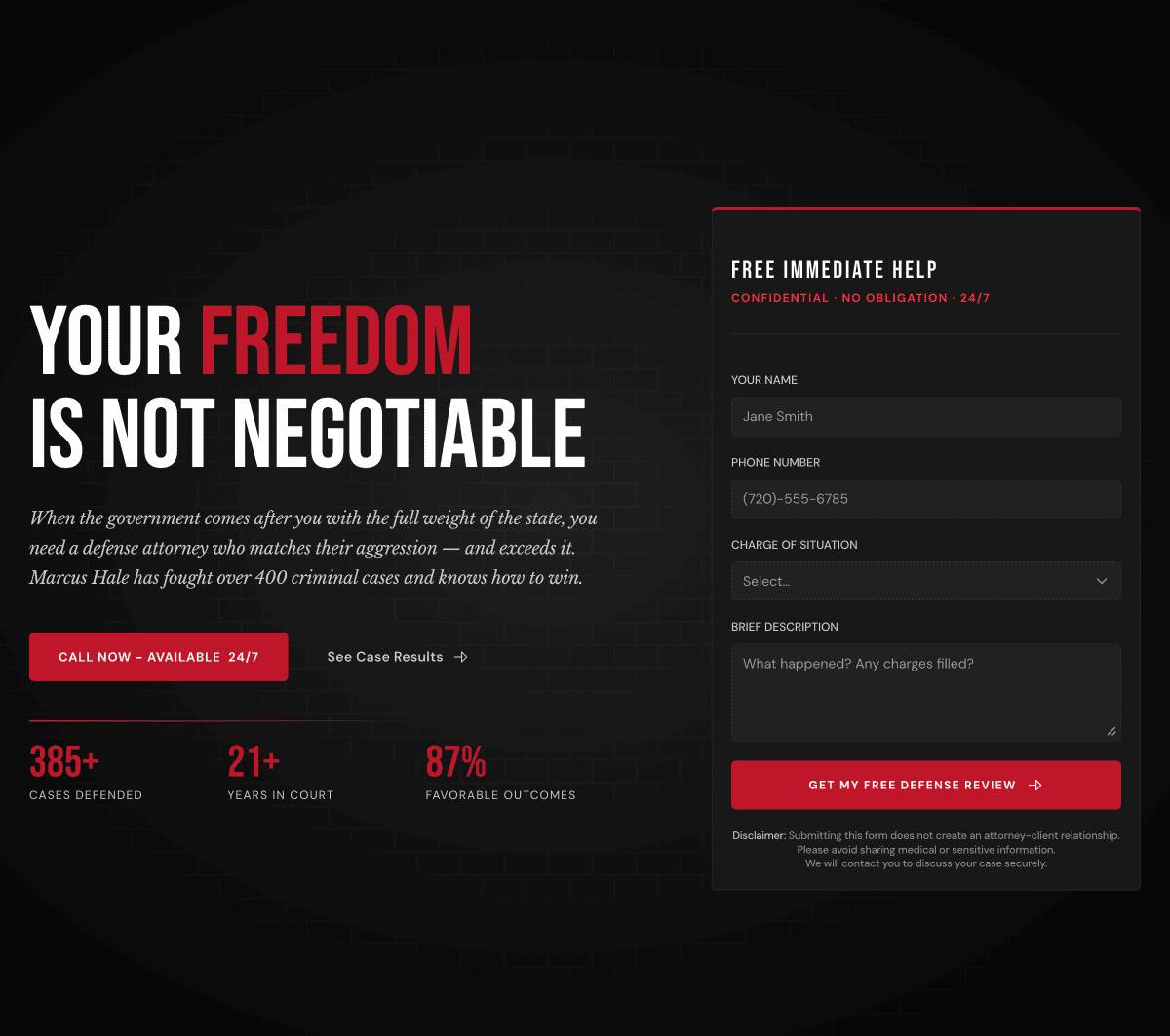
Criminal defense is the highest-stakes practice area in law. The person landing on your site is scared, overwhelmed, and making a decision in minutes. This is a fully built demonstration of how a criminal defense website should be structured, designed, and written to meet that moment.
Practice Area
Criminal Defense
Type
Website
Focus
Urgency & Trust
A person facing criminal charges is not casually browsing. They or someone they love was just arrested. Time is moving fast. Evidence is being logged. Bail hearings are being scheduled. And they're sitting there at midnight Googling "criminal defense attorney" trying to figure out who to call.
Most criminal defense websites greet that person with a generic headline, a stock photo of a courthouse, and a contact form buried at the bottom. They look like every other law firm site, which means they communicate nothing about urgency, nothing about expertise, and nothing that makes that person feel like they've found the right attorney.
It gets worse when you consider what's at stake in this practice area. Personal injury visitors have time. The injury already happened, the decision to get a lawyer can wait a few days. Criminal defense visitors do not have time. The first 24 hours after an arrest are often the most important in the entire case. A website that doesn't reflect that reality is losing clients every week.
Stock courthouse photo. "Experienced attorney fighting for your rights." Phone number in the footer. Contact form with no urgency. Looks identical to ten other attorneys in the same city.
Dark, serious design that matches the gravity of what the person is facing. Contact form above the fold. Outcome-first credibility. 24/7 availability stated from the start. The attorney's voice is present from the first sentence.
The color palette of a criminal defense website is a deliberate choice. A dark, serious design tells the person something before they've read a word: this attorney takes your situation as seriously as you do. It's not about being aggressive or dramatic. It's about matching the emotional weight of what the person is going through.
Compare it to a personal injury site, which uses a lighter, more reassuring palette because the person's primary need is comfort and hope. A criminal defense visitor's primary need is confidence. They need to believe they've found someone capable of fighting back against the full force of the state.
Design is the first thing a person feels before they read anything. On a criminal defense site, it needs to say: I'm serious, I'm capable, and I've been in this room before.
Typography follows the same logic. The headline on this site is set in uppercase, bold, and uncompromising: "YOUR FREEDOM IS NOT NEGOTIABLE." That's not a marketing line. That's a promise stated with the same directness a good defense attorney uses in court. The design amplifies it rather than softening it.
Every section exists because criminal defense visitors have a specific set of fears, questions, and objections that need to be addressed in the right order. Here's what each section does and why it matters.
This is the most important structural decision on the entire page. Personal injury sites can afford to put the contact form lower because the person has time. Criminal defense visitors do not. A contact form visible in the hero means someone who lands at 2am after an arrest can reach out immediately, without scrolling, without navigating anywhere. The form also includes a charge selector so the attorney knows exactly what they're walking into before the first call back.
Directly below the hero: Avvo rating, AV Martindale badge, Super Lawyers, Million Dollar Advocates. These aren't decorations. They're the fastest way to answer "is this person actually good?" for someone who has never heard of the attorney. A visitor who lands cold can verify credibility in under three seconds without reading a word.
Unlike personal injury, where results are measured in dollar amounts, criminal defense results are measured in freedom. Each case result card shows the outcome prominently, followed by a brief explanation of how it was achieved. This matters because it shows not just that the attorney wins, but how they win. Someone facing a Fourth Amendment issue reads about a suppression victory and thinks: that could be my case.
If an attorney spent years as a prosecutor, that fact belongs everywhere on the site, not buried in a bio paragraph. It answers the person's most important unspoken question: does this attorney actually understand how the other side thinks? The bio is written entirely around this, with the attorney speaking directly: "I spent six years prosecuting cases. I know every tactic they will use before they use it." That's not a marketing claim. It's a fact that changes how a prospect sees the attorney from the first read.
Nobody searches "violent crime attorney." They search "assault lawyer" or "DUI attorney" or "drug trafficking defense." The defense areas section is organized around the actual language people use when they're in trouble. Each area also briefly explains the approach for that specific charge type, which shows expertise rather than just listing practice areas.
Most people have never been through the criminal justice system. They're scared of the outcome, but they're also scared of the process because they don't know what comes next or what they should do at each step. An eight-step walkthrough from arrest through trial educates the person and demonstrates the attorney's command of the full process. Every step notes how having an attorney changes the outcome at that stage. By the time someone finishes reading it, they're ready to call.
Each testimonial card leads with the case result, "ALL CHARGES DISMISSED" or "NOT GUILTY," before the person reads a single word of the testimonial. The story only lands if the person already knows it ended well. The testimonials are also written in the client's voice, not cleaned-up legal language, which is what makes them feel real.
The FAQ on a criminal defense site carries real weight. Questions like "Should I talk to police?" and "Do I need a lawyer if I'm innocent?" are things people feel embarrassed to ask out loud. Answering them on the page removes that hesitation and gives the person what they need to make a decision. Each answer also quietly reinforces why waiting is costly, which becomes a natural push toward reaching out without ever saying "hire us."
The sticky mobile bar has two buttons that stay on screen at all times: Call Now and Can't Talk, Leave a Message. That second button matters more than it looks. Someone sitting in a waiting room or standing somewhere public can't always make a call. Giving them a message option means they don't have to wait for a better moment, and the attorney gets the inquiry either way.
The sticky mobile bar has two buttons that stay on screen at all times: Call Now and Can't Talk, Leave a Message. That second button matters more than it looks. Someone sitting in a waiting room or standing somewhere public can't always make a call. Giving them a message option means they don't have to wait for a better moment, and the attorney gets the inquiry either way.
Not every person can call the moment they decide they need an attorney. They might be in a public place, at work, or just unable to speak freely. A message option captures those people where a call-only button would lose them entirely. Both buttons stay visible no matter how far down the page the person scrolls.
05 — Design Decisions
The deep charcoal and black background is not a style choice for its own sake. It signals that this attorney operates in serious, high-stakes territory. People looking for criminal defense respond to authority and weight. A dark, controlled design communicates both before a single word is read.
One accent color, an urgen red, is used only for the most important elements: the primary CTA button, credential labels, and key stats. It reads as premium and serious without being flashy. Against a dark background it pulls attention without needing to shout.
The primary headline, "YOUR FREEDOM IS NOT NEGOTIABLE," is set in uppercase because the subject demands it. This is not a site for someone browsing options casually. The typography signals that the attorney understands exactly what the person is facing and will meet it head on.
A full portrait of the attorney sits alongside the bio. In criminal defense, trust is deeply personal. The person visiting needs to see who they are putting their freedom in the hands of. The photo is confident and direct, not a polished corporate headshot, but present and authoritative.
Contact form above the fold, the most important structural decision for criminal defense where time is everything
Charge dropdown in the form so the attorney knows what they're walking into before the first conversation
Case results shown as ACQUITTED, DISMISSED, NOT GUILTY — the language of freedom, not compensation
24/7 availability stated in the nav, the sticky bar, and the final CTA because repetition of this fact matters in criminal defense
Confidentiality language repeated throughout because many people are afraid of the consultation itself
FAQ answers written with quiet urgency built in, every answer reinforces why waiting costs you
"What Happens After an Arrest" positions the attorney as the guide through a process most people have never seen before
Everything on this site was built around one simple reality: the person visiting is already in crisis. They're not comparing options over a few days. They're making a decision in minutes, usually from their phone, usually late at night. The site is built to meet them right there.
The site doesn't try to close every person with the same message. It offers multiple ways in — the hero form, the call button, the mid-page CTA, the sticky bar — because people arrive at different levels of readiness. Some fill out the form immediately. Some read through the case results first. Some need to read the full arrest process walkthrough before they're ready to reach out. All of them find what they need.
A criminal defense website isn't just marketing. It's the attorney's first argument for why this person should trust them with the most important decision of their life.
See the Website