Immigration law serves some of the most vulnerable people who will ever visit a law firm website. They come from different countries, speak different languages, and carry years of uncertainty with them. This is a fully built demonstration of how an immigration website earns trust, removes barriers, and turns that first visit into a consultation.
Practice Area
Immigration Law
Type
Website
Focus
Trust & Accessibility
Most immigration law websites look like they were built to impress other attorneys, not the families actually searching for help. Dense legal language, complicated navigation, and no acknowledgment that the person reading might not be a native English speaker. For a practice area that serves people from every corner of the world, that's a serious disconnect.
The immigration client is not like a personal injury client or a criminal defense client. They're not always in crisis. They're often planning something hopeful: bringing a spouse to the country, getting a green card, becoming a citizen. But they're also scared of getting it wrong. Immigration cases have long timelines, complex paperwork, and consequences that follow families for years. A website that doesn't acknowledge that reality loses them before they ever pick up the phone.
There's also a trust problem specific to immigration. Many clients have heard stories of notarios or unqualified consultants who took their money and made things worse. They approach any attorney website with real skepticism. The site has to work harder to establish credibility than it would for any other practice area.
English only. Legal terminology without explanation. Hourly billing with no pricing transparency. A single generic contact form. No sense of who the attorneys are or why they do this work.
Multiple languages. Plain language explanations of every practice area. Flat fees published upfront. Attorney bios that show the human behind the credential. A site that feels like walking into a firm that actually wants to help.
The design challenge with an immigration website is finding the balance between approachability and authority. Too cold and the client feels like a case number. Too casual and they wonder whether this firm is serious enough to handle their future.
This site uses a warm, natural palette: forest green and soft cream with clean white space. It reads as trustworthy and grounded without the intimidating formality of a corporate law firm. The typography is elegant but readable. The photography is genuine, showing real attorneys rather than stock images of scales and flags.
The person visiting an immigration website has probably already been failed by someone before. The design needs to make them feel safe enough to try again.
Every visual decision on this site was made to lower the barrier between the person and the consultation. Nothing is hidden, nothing is complicated, and nothing requires the visitor to already know how immigration law works before they can figure out what to do next.
Each section on this site addresses something specific that an immigration client needs to know before they'll commit to reaching out. Here's what each one does and why it's there.
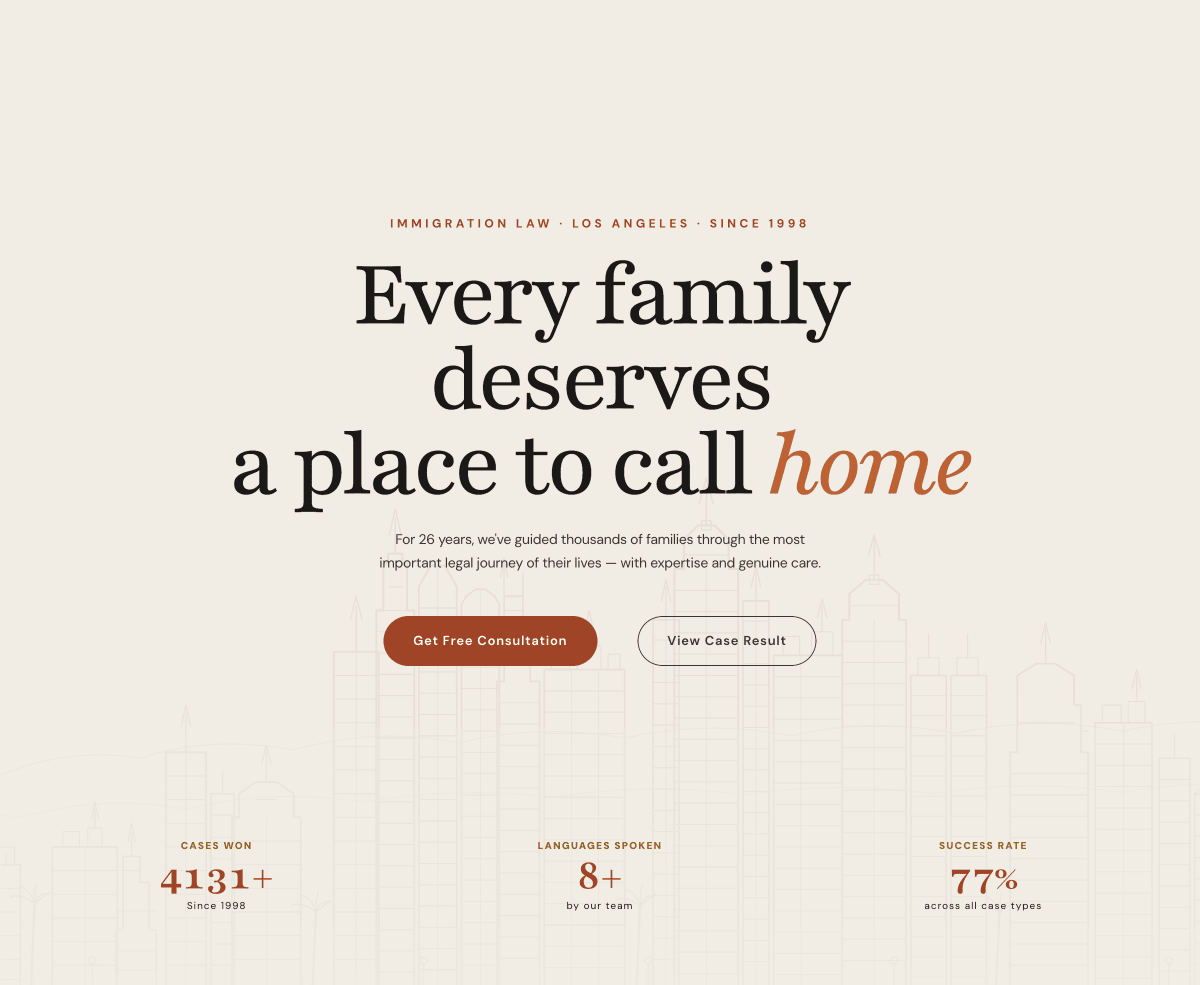
The headline, "Every family deserves a place to call home," puts the client's story first before the firm's credentials appear anywhere. This is intentional. Immigration clients respond to empathy before authority. The subheadline then establishes experience in one sentence: 26 years, thousands of families. Two CTAs sit side by side: one for people ready to book, one for people who want to see results first. Both types of visitors are served from the very first scroll.
Displaying 14 languages spoken by the firm is not a feature list. It's a direct message to a huge portion of the visitor base: we can actually talk to you. An immigration client who finds a firm that speaks their language goes from cautious to interested in seconds. This section is placed high on the page because it's one of the most powerful trust signals the firm has. It doesn't just list the languages, it names them in their native scripts, which tells the visitor it's real, not performative.
Most law firms hide their fees behind "contact us for a consultation." Immigration clients, many of whom are watching every dollar, find this frustrating and suspicious. Publishing flat fees upfront, before any commitment, removes one of the biggest barriers to reaching out. It also signals confidence: a firm that shows its pricing is a firm that isn't worried about losing clients over it. The fee table on this site lists actual dollar amounts for the most common case types, which immediately answers the question most clients are too afraid to ask first.
A 98% success rate is a strong number, but it means more when it sits alongside specific case outcomes: a father of three with 18 years in the country whose removal was cancelled, an asylum application approved on 9th Circuit appeal after two prior denials with other counsel, an O-1A visa approved in 14 days. These are the stories that make a percentage real. Each result includes the category of case and what made it difficult, so the visitor reading it can find their own situation somewhere in there.
In a multi-attorney firm, showing the team is not optional. It's what makes the firm feel real. Each attorney card shows a photo, their specialty, years of experience, and the languages they speak. The founding attorney's bio includes a personal reason for why she does this work, which is the most important thing on the page. A founding partner who became an immigration attorney because her own family went through the process is a fundamentally different proposition than a firm that just practices immigration law. That story belongs front and center.
Every practice area is described in plain language, starting with what the client cares about rather than what the visa is called. "Reuniting spouses, children, parents and siblings" tells the client more about whether they're in the right place than "Family-Based I-130 petitions" ever could. Specific visa types are listed after the plain-language description for clients who already know what they need. This structure serves both audiences at once.
One of the biggest reasons immigration clients hesitate to reach out is that they don't know what happens next. The How It Works section walks through four clear steps: free consultation, legal strategy and flat-fee quote, preparation and filing, resolution and ongoing support. What makes this section work is the detail inside each step. "Provides flat-fee pricing in writing before you sign anything" directly addresses the fear of surprise bills. "You receive regular updates and immediate notification of any government correspondence" addresses the fear of being left in the dark. These are not vague promises. They're specific answers to specific anxieties.
The consultation form on this site includes a field most law firm forms miss: preferred language. This one addition tells the visitor that the firm actually thought about them when building the site. The case type dropdown uses plain language categories, not legal codes. The form copy emphasizes confidentiality multiple times because immigration clients are often genuinely afraid of what happens to their information. All of this reduces the hesitation between "I want to reach out" and "I'm actually submitting."
The FAQ addresses real concerns: what does this cost, what if my case was already denied, what if I got a deportation notice, is the consultation really confidential. These are not easy questions for someone to ask a stranger on the phone. Having the answers already on the page removes the vulnerability from that first interaction. The FAQ also has a live "Ask Us Directly" link that carries the visitor straight into the consultation form, so it becomes its own quiet conversion path.
Most law firms that work with non-English speaking clients mention language capability somewhere in the footer or in a single sentence in the About section. This site treats multilingual capability as a primary feature of the firm, displayed prominently and named explicitly in the native script of each language.
Español
中文
Tagalog
हिंदी
Português
عربي
한국어
Français
Русский
Việt
Polski
English
日本語
Italiano
The reason this works is psychological as much as practical. A Spanish-speaking client who sees "Español" in their own script, not just "Spanish" in English, knows immediately that this firm is not just claiming to help them. They thought about them when building the site. That difference registers before a single sentence is read.
An immigration firm that shows 14 languages on its website is not just accessible. It's telling the market something specific: we built this practice around people from every background, not just English speakers who happen to need immigration help. That distinction changes who reaches out, and how confident they feel when they do.
05 — Pricing Transparency
Almost no law firms publish their fees publicly. The standard approach is to get the client on the phone or into an office first, then discuss pricing. There are practical reasons for this: cases vary, complexity varies, and attorneys don't want to lose a prospect over a number before they've had the chance to explain the value.
But immigration clients are a specific audience. Many of them have saved for years for their case. Many have been burned by unqualified help that took their money. Price opacity is not neutral to this audience. It reads as suspicious. Publishing flat fees openly changes the entire dynamic.
05 — Design Decisions
Forest green and warm cream sit at the opposite end of the spectrum from the dark, aggressive palette of a criminal defense site. The color says: you are safe here. This is a place where families are helped, not just processed. It carries warmth without sacrificing professionalism.
Every attorney on this site has a photo that looks like a person, not a stock image. The founding partner's photo in particular is given full treatment because her personal story is the firm's strongest differentiator. Seeing the actual attorneys builds trust that no credentials list can replicate on its own.
Case outcomes are shown not just as approvals but as human situations: a father of three with 18 years in the country, an asylum applicant with two prior denials. Numbers get attention. Stories get remembered. The combination of both is what makes a results section convincing.
Each client testimonial is written in plain, unpolished language because that's how real people talk. "Our family is finally complete" says more than any marketing line the firm could write for itself. Authentic voices build more trust than polished endorsements.
Languages shown in native scripts, not just English translations, because the visual recognition is the point
Flat fees published openly and early, before the visitor has to ask or book a consultation to find out
Founding partner bio includes a personal immigration story, making the firm's reason for existing clear
Practice areas written for someone who doesn't know immigration law, plain language first, visa codes second
Consultation form includes a language preference field because most law firm forms don't and it matters
Confidentiality mentioned multiple times throughout the page because immigration clients are genuinely concerned about this
Deportation defense section includes emergency contact language because those cases cannot wait
Mid-page CTA placed after the team section at peak trust, not just at the bottom of the page
FAQ answers written directly, no legal hedging, treating the visitor as someone who deserves a straight answer
Immigration clients come to a website carrying more than a legal question. They come with fear about their future, skepticism from past experiences, and in many cases a language barrier that makes everything harder. A site that only speaks to the legal competence of the firm and ignores all of that is missing most of the conversion opportunity.
This site earns trust through transparency, specificity, and warmth. Every design decision, every section, and every piece of copy was written to reduce the distance between a person who needs immigration help and an attorney who can provide it. The live site at the bottom of this page is the proof of that.
An immigration website has one job above all others: make the person feel safe enough to reach out. Everything else follows from that.
See the Website